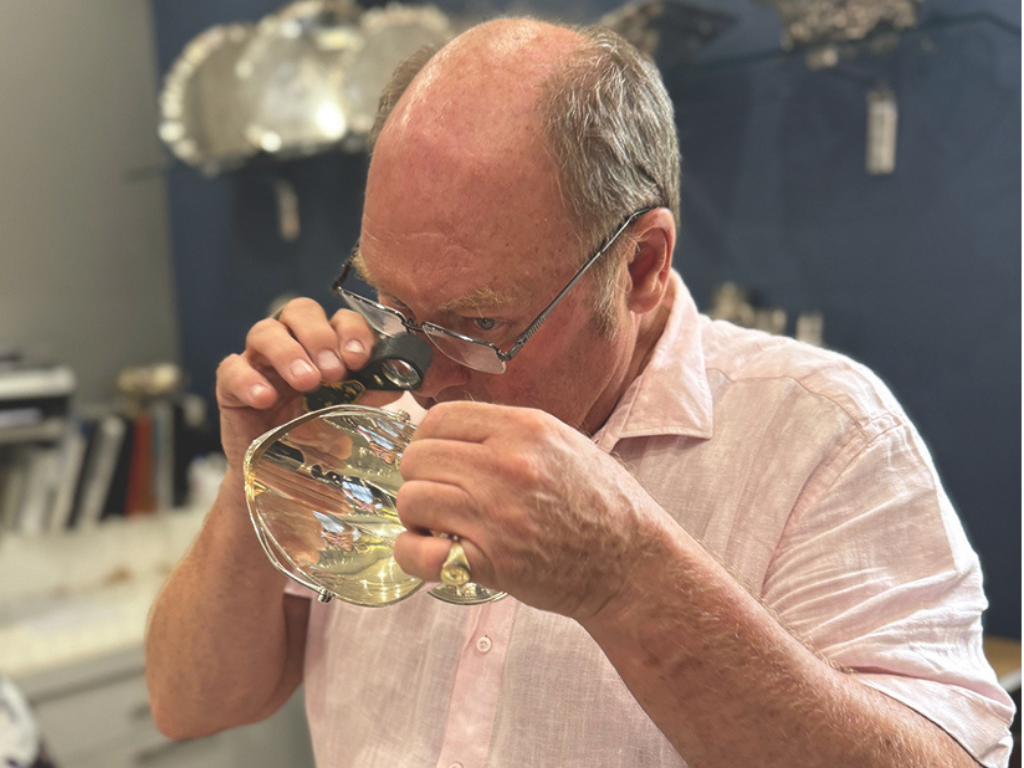
If you’ve inherited a set of silverware, or if you’ve been quietly building a collection for years, you’ve probably turned a piece over to squint at the cluster of tiny stamps on its surface.
Those marks aren’t random decorations, they’re hallmarks! Hallmarks are an official record, struck by an independent authority, of exactly what that piece is made of, where it was tested, and when.
Unlike a maker’s signature, which tells you who made something, a hallmark tells you what it is and proves it was verified. That distinction matters enormously when you’re trying to establish value. A fully hallmarked piece of antique silver carries a paper trail that goes back centuries. An unmarked piece, however beautiful, raises questions that are much harder to answer.
Understanding hallmarks doesn’t require years of study. Once you know what you’re looking at, the marks start to tell their own story, which often turns out to be truly fascinating.
What Are Hallmarks?
Hallmarks are a system of official marks applied by an assay office, which is an independent body authorised to test precious metals, to certify that a piece meets the required standard of purity. The silversmith makes the piece and submits it. The assay office tests it. If it passes, the marks are struck. If it doesn’t, it’s returned or destroyed.
How Do Hallmarks Work?
A full British hallmark is made up of several component marks, each carrying distinct information. You’ll typically find the maker’s mark, which identifies who made or submitted the piece. Then the standard mark, which confirms the metal’s purity. Then the assay office mark, which tells you where it was tested. And finally the date letter, which records the year it was assayed. On older pieces you may also find a duty mark, which we’ll come to shortly.
You don’t need to read all of these at once. Each mark can be decoded separately, and put together to build a picture of the provenance of your piece of antique silver.
A Brief History of Hallmarking
British hallmarking is one of the oldest forms of consumer protection in the world. It dates to 1300, when Edward I decreed that no silver could be sold unless it had first been assayed and marked by the Wardens of the Goldsmiths’ Company in London. The standard required was the same as the coinage of the day, what is now called the sterling standard of 92.5% pure silver, and the mark struck to confirm it was at first, a leopard’s head. In 1544, King Henry VIII’s administration decided the lion passant as the new nationwide standard mark for sterling silver purity.
That system is now more than 700 years old, and has evolved considerably but, importantly, has never been broken or removed. The Goldsmiths’ Company in London remained the dominant assay authority for centuries, but as the silver trade grew and spread, new offices were established to serve regional industries.
Birmingham and Sheffield received their assay offices in 1773, largely through the lobbying of Matthew Boulton, who successfully argued that sending work to London for assay was ruinously expensive for Midlands manufacturers. Edinburgh, Chester, Newcastle, Exeter, and Dublin all had their own offices at various points, each with its own town mark and date letter cycle.
The significance of this history for collectors is straightforward. Because the system was compulsory, consistent, and independently administered, the marks it produced are genuinely trustworthy. A date letter is not the maker’s claim about when a piece was made. It’s an official stamp from an independent body recording when that piece was tested, which is a meaningful distinction for collectors.
What Are the Different Types of Hallmark?
Town Mark
Also called the assy office mark, the town mark is the symbol that identifies which assay office tested and stamped the piece. Each office had its own device, and these remained consistent enough over time to be reliably identified.
London used a leopard’s head, which appears in various forms from the medieval period onwards. Birmingham used an anchor, which often surprises people, given Birmingham is landlocked, though the story that it was chosen at a coin toss in a London pub has some historical support. Sheffield used a crown until 1975, when it switched to a rose. Edinburgh used a castle. Dublin used a crowned harp. Chester used a set of wheatsheaves with a sword. Exeter used a castle with three towers.
Knowing the town mark immediately tells you where a piece was assayed, which in turn tells you which date letter cycle to use when working out the year, and often something about the likely origin of the piece itself.
Date Mark
The date letter is a single letter of the alphabet, enclosed in a shaped shield, that records the year in which a piece was assayed. Each assay office ran its own cycle of letters, changing the letter annually and varying the typeface and shield shape between cycles to prevent confusion between years.
This is where many people hit their first wall. Because each office ran its own independent cycle, the same letter in the same year looks different depending on where the piece was tested and the cycles didn’t all start in the same year or follow the same sequence. An “M” from London in a plain shield means something entirely different from an “M” from Birmingham in a different shield.
The practical approach is always to identify the town mark first, then consult a date letter table for that specific office. Reference resources (like silvermakersmarks.co.uk) present these cycles office by office, which makes the process considerably more manageable than it sounds.
Maker’s Mark
The maker’s mark identifies the silversmith or company that made or, more precisely, submitted the piece for assay. It’s usually a set of initials within a shaped cartouche, though the cartouche shape, the lettering style, and any additional devices all carry information that helps with identification.
It’s worth knowing that the maker’s mark doesn’t always mean the person whose initials appear actually made the piece with their own hands. In larger workshops, a master silversmith would submit work produced by their employees. Retailers sometimes entered their own marks on pieces they commissioned from independent makers. And when a workshop changed hands, the new owner might enter a new mark with the same or similar initials.
This is why the maker’s mark is best read alongside the other hallmarks rather than in isolation. Cross-referencing the initials against the date letter and assay office mark is what turns a possible attribution into a confident one. Online databases like the aforementioned silvermakersmarks.co.uk allow you to search by initials and filter by office and period, which is a useful starting point though it’s worth mentioning that their list isn’t exhaustive, particularly for provincial makers.
Sterling Silver Mark
The standard mark confirms the purity of the metal. For sterling silver (i.e. 92.5% pure silver) the mark used in England, Wales, and Northern Ireland is the lion passant: a lion walking to the left, with its right forepaw raised. It’s one of the most recognisable symbols in the decorative arts and has been used in various forms since the 16th century.
Scotland used a different mark: a lion rampant, standing upright on its hind legs. Ireland used a figure of Hibernia (a seated woman) which was introduced in 1730. These regional variations are worth knowing because they can initially look unfamiliar if you’re accustomed to the English lion passant.
There is also a higher standard: Britannia silver, which is 95.8% pure. This was actually the compulsory standard in England between 1697 and 1720, introduced to prevent silversmiths from melting down coinage. Pieces from this period carry a figure of Britannia and a lion’s head erased (a head without a neck) rather than the lion passant. The Britannia standard remained available as an option after 1720 and is occasionally seen on later pieces, though it’s far less common.
Duty Mark
Between 1784 and 1890, a fifth mark was added to British silver: the duty mark, which took the form of the reigning monarch’s head in profile. Its purpose was simple: it confirmed that the excise duty on silver had been paid.
The duty mark changed with each monarch. George III, George IV, William IV, and Victoria all appear, making the duty mark a useful secondary dating tool even before you consult the date letter. A piece bearing a young Queen Victoria in profile, for example, was assayed in the earlier part of her reign.
The duty mark was abolished in 1890, so its presence immediately tells you a piece predates that year. Its absence doesn’t tell you much; it might predate 1784, or postdate 1890, or it may simply have been struck lightly and worn away. But when it’s present and legible, it’s a helpful additional data point.
What Does Each Symbol Mean?
Once you know what the individual marks are, reading them on an actual piece becomes a process of working through them one by one.
Start with the standard mark. If you can see a lion passant, you’re looking at English sterling silver. A lion rampant points to Scotland. Britannia and the lion’s head erased suggests the period 1697 to 1720, or a later piece deliberately made to the higher standard. This first step tells you roughly what you’re dealing with and which other marks to expect.
Next, find the assay office mark. The anchor, the leopard’s head, the castle, the crown, the harp and so on. Once you’ve identified the town mark, you know which office to look up and which date letter cycle applies.
Then turn to the date letter. Armed with the correct office, you can consult a date letter table and match the letter, its typeface, and the shape of the shield to a specific year. This is the step that converts “Victorian” into “1873” and that precision can make a real difference to valuation.
Finally, examine the maker’s mark. The initials, the cartouche, and any accompanying devices can then be cross-referenced against the period and office you’ve already established. This is where even experienced collectors sometimes need additional resources, because the range of registered makers across three centuries is enormous.
One important caveat: date letters reset on a cycle, and the same letter appears multiple times across a single office’s history. An “A” from the London office might represent 1716, 1736, 1756, and so on depending on the cycle. The shield shape and typeface change between cycles to distinguish them, but on a worn piece these differences can be subtle. When in doubt, the style of the piece itself, its form, decoration, and weight, should be consistent with the date you’ve arrived at. If it isn’t, it’s worth looking again.
How to Photograph Hallmarks
Good photography is the foundation of any remote identification. A blurry, flat, or overlit image of a hallmark isn’t useful for identification purposes. However, the same mark, photographed well, can often be read clearly even when it’s quite worn.
-
Clean the surface gently first.
A soft, dry cloth to remove loose tarnish is fine. Avoid chemical cleaners near the marks, as these can sit in the recesses and obscure fine detail. Don’t attempt to polish the marks themselves.
-
Use raking light.
This is the single most important step. Position a small LED torch or desk lamp so that the light strikes the surface at a very low angle so it is almost parallel to it. This creates shadows in the recesses of the stamped marks and makes the impression legible. Overhead or diffused light flattens everything and is the enemy of hallmark photography.
-
Stabilise the piece.
A piece that shifts between shots wastes time. Use a folded cloth, a ring of museum putty, or a small beanbag to hold the relevant surface steady and as flat to the camera as possible.
-
Use your phone’s macro mode.
Most modern smartphones can focus closely enough for hallmark photography if you tap to focus directly on the marks. For very fine or worn marks, a clip-on macro lens is inexpensive and makes a significant difference.
-
Avoid flash.
Direct flash on silver creates blown-out reflections that obscure the very detail you need. Turn flash off and work with controlled directional light instead.
-
Take multiple shots at slightly different angles.
A mark that’s invisible from one angle often becomes legible when the light shifts by a few degrees. Take at least four or five frames and review them at full zoom before moving on.
Once you have clear images, zoom in on screen to examine the cartouche shapes, the letter forms, and any devices alongside the initials. Sharing well-photographed hallmarks with a specialist is far more likely to produce a useful result than attempting to describe marks in words.
How to Cross-Reference Hallmarks
Cross-referencing is how you move from “I think this might be…” to “this piece was assayed at Birmingham in 1847.” The logic is sequential, and the process is more straightforward than it looks once you have a method.
-
Start with the assay office mark.
Identify the town mark first, because everything else depends on it. The office determines which date letter cycle applies and often gives you a geographic starting point for your research.
-
Use the date letter cycle for that office.
Once you know the office, consult a date letter table. Most reference resources present these clearly, office by office. Match the letter, its typeface, and the shield shape to a specific year. If two possible years fit, use the style and form of the piece to decide between them.
-
Cross-check the maker’s mark against the period you’ve established.
If your date letter puts a piece at 1780, you’re looking for a maker active at that time and registered with that office. Online databases allow you to search by initials and filter by office and period. Jackson’s Silver and Gold Marks of England, Scotland and Ireland remains the authoritative printed reference and is worth consulting for anything significant.
-
Be alert to complications.
Later repairs, replacements, or alterations can result in marks from different periods appearing on the same piece. Transposed marks, where a small marked section has been cut from one piece and inserted into another, do exist, and aren’t always immediately obvious. If the marks on a piece don’t tell a consistent story, that inconsistency itself is information worth noting.
-
Check the duty mark if present.
As noted above, the monarch’s head confirms a pre-1890 date and gives you a secondary check on the period established by the date letter.
Building a picture from multiple marks, each confirming what the others suggest, is what produces a reliable identification.
Look at it this way: a single mark in isolation is a clue and several marks pointing to the same conclusion is evidence.
When to Ask an Expert
Hallmarks are remarkably informative, but they’re not infallible guides. Marks can be worn to illegibility on pieces that have been polished repeatedly over decades and can be struck poorly at the point of manufacture. In rarer cases, marks have been faked by either applying fraudulently to substandard metal or transposed from one piece to another to suggest a provenance that doesn’t exist.
Even without any of these complications, some marks are genuinely ambiguous. A date letter that sits between two possible cycles, a maker’s mark where the initials match several registered silversmiths from the same period, an assay office mark that’s partially obscured; these are situations where experience counts for considerably more than database searches.
Professional assessment should be viewed as a last resort but rather as the step that turns a best guess into a confident, documented valuation. We consider this an invaluable step, regardless of your intent; whether you’re considering a sale, arranging insurance, or simply wanting to know what you actually have.
At Beau Nash, hallmark identification is central to how we work. Every piece in our collection has been examined and documented with care, and when clients bring pieces to us for valuation, that same knowledge is what we bring to bear.
If you have silver whose marks you’d like properly assessed, our valuing and buying antique silver page explains how we approach that process. And if you’d like to see hallmarked pieces in context, browse our current collection of antique silver as every piece is described with the accuracy that good silver deserves.