Georgian silver is English silver made between 1714 and 1830, spanning the reigns of Georges I to IV, a period in British history that is known as “Georgian”.
It is one of the most collected categories of antique silver in the world, and yet there are a lot of common misconceptions.
If you have inherited a candlestick or spotted a salver in an antiques shop window and wondered what actually makes it “Georgian”, this guide covers the basics: the period, the standard, the styles, and what to check before you buy.
Georgian silver defined: 1714 to 1830, the reign of four King Georges
The Georgian era takes its name from the four King Georges who occupied the British throne in succession: George I (1714 to 1727), George II (1727 to 1760), George III (1760 to 1820), and George IV (1820 to 1830). Silver made across this whole span is loosely described as “Georgian”, but many specialists and collectors break the period down further and focus on a single reign, since taste and technique shifted considerably over more than a century.
It helps to think of “Georgian” as a broad umbrella term rather than a single fixed style. A plain, engraved coffee pot from the early 1720s and an ornate, heavily embossed centrepiece from the 1820s can both correctly be called Georgian silver, despite looking almost nothing alike. Understanding roughly where in the period a piece sits is the foundation for everything else, including its style, its likely maker, and its value.
Is Georgian Silver the same as Sterling Silver?
Georgian silver is sterling silver, meaning it is 92.5% pure silver, with the remaining 7.5% typically made up of copper to give the metal strength and durability. Pure silver on its own is too soft for most practical objects; the addition of copper allows a teapot, a candlestick or a set of cutlery to hold its shape and survive daily use.
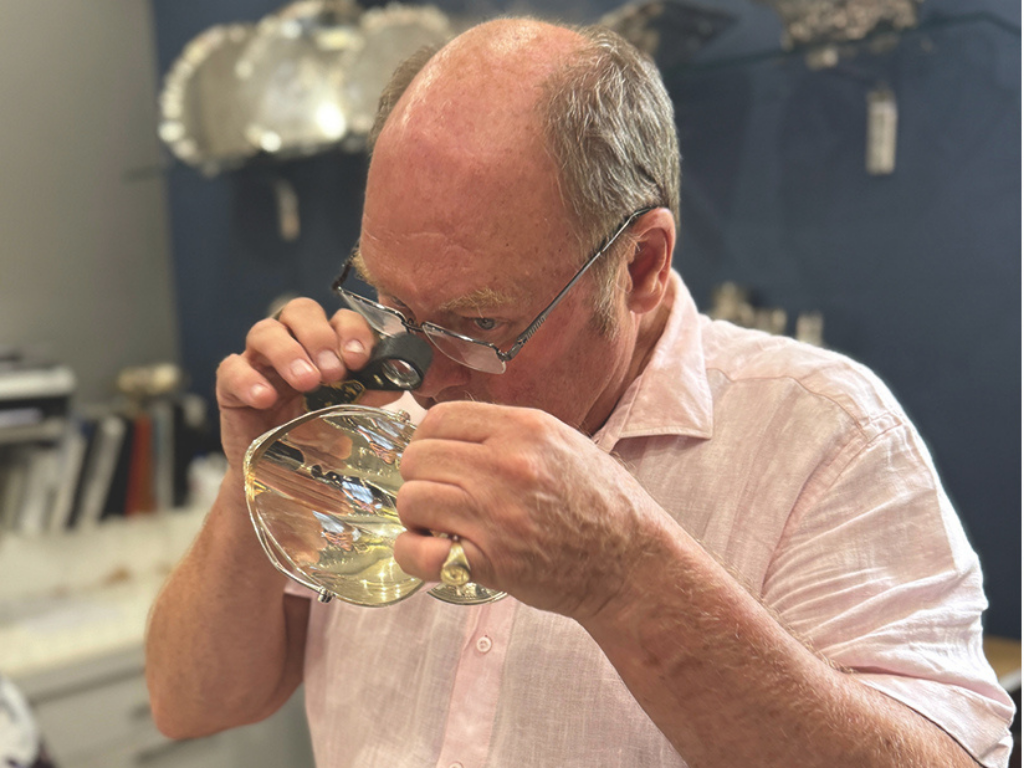
To confirm that a piece meets this standard, English silver has been hallmarked since long before the Georgian period. A genuine piece will carry a small set of stamped marks, usually on the base or the underside, and understanding what each one tells you is the single most useful skill for a new collector to learn.
How do you read a Georgian hallmark?
A full English hallmark from this period typically carries four marks, each telling you something different:
- The lion passant, a walking lion shown in profile, confirming the sterling standard of 92.5% purity
- A town mark, showing which assay office tested and marked the piece, such as a leopard’s head for London or an anchor for Birmingham
- A date letter, a single letter in a specific typeface and shield shape that changed annually, allowing a piece to be dated precisely
- The maker’s mark, usually the initials of the silversmith or workshop responsible for the piece
- A duty mark. Started by George III in 1784 and abolished during Victorian times in 1890, the duty mark was introduced as a sovereign’s head profile stamp to show that tax (duty) had been paid to the Crown on the silver item.
A full, clear set of these four marks matters for two reasons: it confirms the piece is genuine sterling silver, and it allows a specific maker and year to be identified, both of which affect value considerably. Marks that are worn, partial, or appear to have been altered are worth having checked by a specialist before you buy. However worn or partial marks should not be a deterrent when buying old silver, as silver was used daily during those times and overzealous Georgian housekeepers can be a bit too eager to shine up the pieces, rubbing off the marks. Worn marks actually add to the charm, and a specialist would be happy to tell you more about it.
For more information please see our blog about identifying silver hallmark.
The styles within Georgian silver: Rococo, Neoclassical, Adam, Regency and Hanoverian
Over the course of more than a hundred years, Georgian silver moved through several distinct stylistic phases:
Early Georgian (George I)
This period is typified by relatively plain forms with clean, engraved decoration, reflecting the restrained taste of the period
Rococo (from the 1730s)
An elaborate, asymmetrical style arriving from France, characterised by scrolling shells, flowers and naturalistic ornament, often heavily embossed or chased
Neoclassical and Adam (from the 1760s)
A reaction against Rococo excess, drawing on classical Greek and Roman motifs, with restrained, symmetrical forms popularised by architect Robert Adam
Regency (early 1800s to 1830)
A return to grander, more sculptural forms, often with a heavier, more opulent feel than the Neoclassical period that preceded it.
Recognising which of these styles a piece belongs to is often the quickest way to narrow down when it was made, even before checking the hallmark.
Hanoverian (used only for flatware)
The Hanoverian pattern is an iconic design of silver flatware introduced to Britain in the early 18th century, named after the House of Hanover following the ascension of King George I in 1714. It represents a major transition point in British silver design, shifting away from earlier 17th-century shapes like the “Dog Nose” or “Trefid” patterns into a sleeker, more balanced form.
Popular from roughly 1710 through 1770, the turned-up terminal design was practically suited to table settings of the era: flatware was set face-down on the dining table, showing off family crests or monograms usually engraved on the back of the handle.
As table etiquette evolved toward placing flatware face-up in the late 18th century, the Hanoverian pattern gave way to the Old English pattern, which flipped the handle tip downward so it sat flush against the table surface.
Some of its Key Design Characteristics include:
- Turned-Up Stem Tip: The end of the handle (terminal) curves upward toward the front of the piece, unlike modern flatware which generally turns down.
- Central Front Rib: A distinctive raised, vertical ridge or line runs down the front center of the handle stem, tapering off toward the bowl or tines.
- Oval Spoon Bowls: The bowls are elongated and egg-shaped (oval) rather than round, featuring a distinctive drop or “rattail” reinforcing seam where the stem joins the back of the bowl.
- Three-Tined Forks: Matching Hanoverian forks from the period typically feature three tines rather than four.
Common forms: tea sets, candlesticks, salvers and more
Georgian silversmiths produced a wide range of everyday and ceremonial objects, many of which are still functional and collectable today:
- Tea and coffee services, including pots, jugs and sugar bowls
- Candlesticks and candelabra, in single sticks or matched pairs
- Salvers and trays, used for serving and presentation
- Sauce boats and tureens, made for the dining table
- Cutlery, including spoons, forks and serving pieces
These are the categories you are most likely to encounter when browsing a specialist dealer, and each has its own conventions around what collectors look for, from matching sets to well-preserved engraving.
What to look for when buying your first piece
If you are buying Georgian silver for the first time, a few checks will serve you well:
- Look for a legible set of hallmarks, and ask the dealer to talk you through what they show.
-
- It’s worth noting though that legible hallmarks are often not available for truly old silver. Furthermore, some types of products like glass bottles with silver collars almost always have lost their marks, because the silver collar is exactly where the item has been polished also; polishing gradually thins out and rubs off marks.
- You should also make sure that if a piece has removable parts (a teapot has a body and a lid connected by a hinge), make sure the marks on the teapot body and the marks of the lid are the same. Otherwise, one of the parts may have been a later replacement.
- Examine condition honestly, including any repairs, replaced parts, or later alterations such as added engraving. It’s always best to see and inspect the item before buying. If you’re buying online and can’t make it to the shop, ask for a video tour using Whatsapp video or Facetime. In today’s age of technology, there should be no reason one cannot inspect an item from where you are.
- Buy from a reputable, established dealer rather than chasing the lowest price online, particularly for higher-value pieces
A trustworthy dealer will be happy to explain a piece’s hallmarks, history and condition in detail, and should welcome questions rather than rushing you towards a sale.
Where Georgian silver fits in a wider collection
For many collectors, Georgian silver becomes a natural starting point for a much wider interest, whether that means focusing on a particular monarch’s reign, following the work of a single silversmith, or building a themed collection around one type of object, such as candlesticks or tea services. Once you understand the period, the standard and the marks, the rest tends to follow.
If you would like to see what genuine Georgian silver looks like in person, browse our current antique silver collection or please do get in touch or come to visit us, we would love to hear from you!